
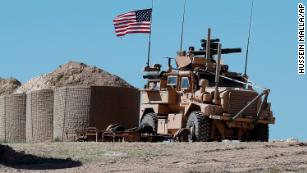
An administration official briefing reporters on Wednesday insisted anyone caught off guard by the decision hasn't been paying attention. But the official did not dispute that some of the President's top advisers were opposed to the withdrawal.
"The President's statements on this topic have been 100% consistent from the campaign through his announcement today, so I think the notion that anyone within the administration was caught unaware, I would challenge that, quite frankly," the official said. "It was the President's decision to make and he made it."
Still, the decision only highlighted discrepancies among administration officials over the future of the roughly 2,000 troops deployed in the country.
Gen. Joseph Dunford, the chairman of the Joint Chiefs of Staff, said this month that the US needed to train thousands of local fighters to ensure a lasting defeat of the terror group. Only last week, the US special envoy to the anti-ISIS coalition Brett McGurk said US forces would remain in Syria even after the terror group was defeated.
"I think it's fair to say Americans will remain on the ground after the physical defeat of the caliphate, until we have the pieces in place to ensure that that defeat is enduring," he said on December 11.
And in September, Bolton told reporters on the margins of the United Nations General Assembly that US troops would remain in Syria to counter Iran.
"We're not going to leave as long as Iranian troops are outside Iranian borders and that includes Iranian proxies and militias," Bolton said.
Pressed about whether Bolton's comments were still applicable, the senior administration official suggested previous statements no longer applied.
"The issue here is that the President has made a decision, and so previous statements ... he gets to do that, that's his prerogative," said the official, briefing reporters during a call organized by the White House.
The official could not provide a timeline for the withdrawal of US troops nor say whether the US would continue to carry out airstrikes in Syria, instead referring questions to the Pentagon.
"It's not information I have," the official said.
If administration officials and Trump's allies in Congress were distressed by the decision, however, there was little excuse for them to be surprised. Trump has long railed against foreign entanglements begun by his predecessors and vowed this spring to bring American troops home.
"We'll be coming out of Syria, like, very soon," he said in April, comments that prompted a hurried effort at the Pentagon and in the National Security Council to convince the President that an immediate withdrawal could throw the region into chaos.
When military brass sought to dissuade him, he grew frustrated and complained at length about the amount of American money being spent in the region, which he said had produced nothing for the US in return, according to senior administration officials.
'Beside themselves'
Despite his annoyance, Trump eventually agreed to hold off on immediately pulling troops from the war-plagued nation, even after airing his displeasure with top national security officials. At one stage, Dunford asked the President to state explicitly what he wanted to see happen in Syria, according to an administration official.
The President responded by saying US troops need to finish their mission against ISIS in Syria within six months, a timeline military officials -- including Mattis -- warned would be too short, according to him.


0 comments:
Post a Comment